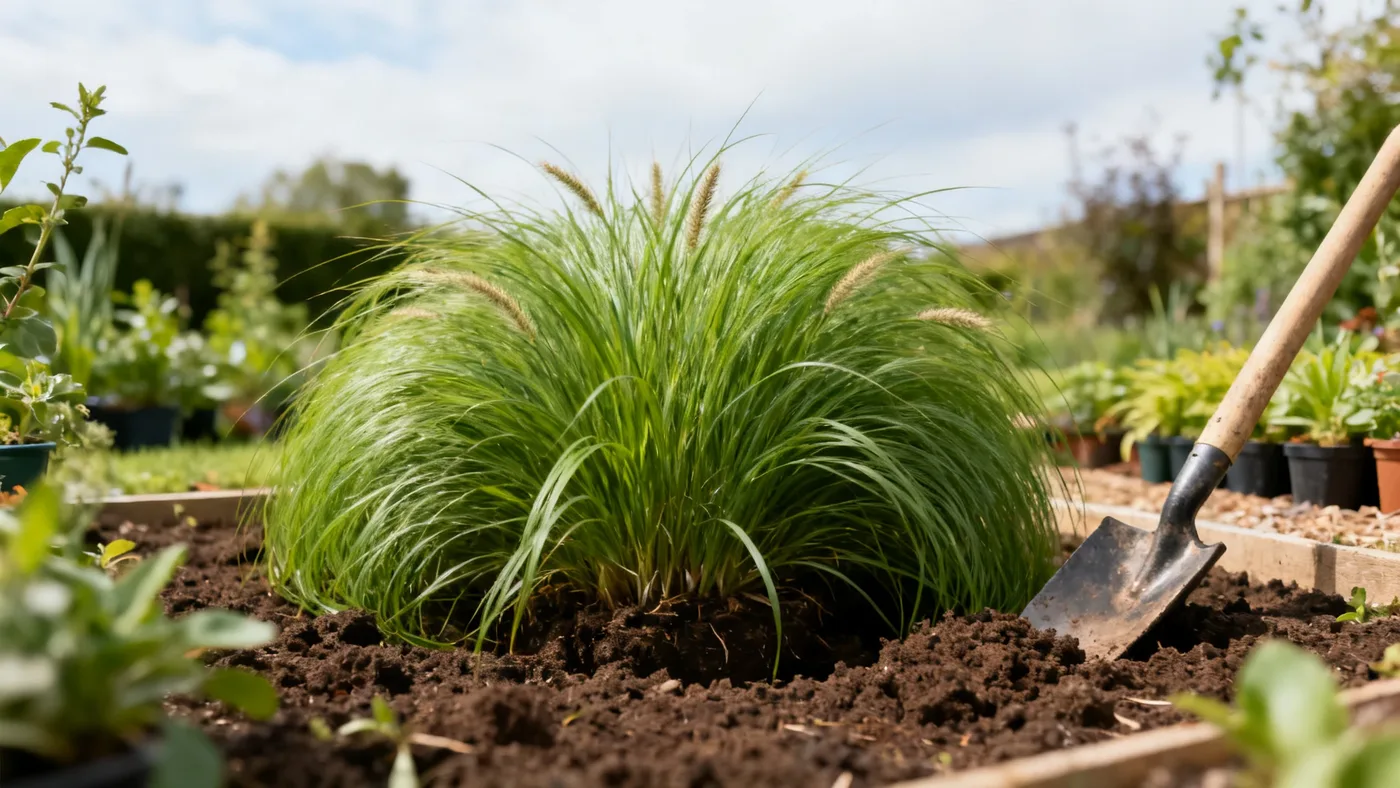
Dwarf Fountain Grass Spacing for Borders and Mass Plantings
Getting spacing right separates a scraggly planting from one that looks full and professional. Dwarf Fountain Grass (Pennisetum alopecuroides 'Hameln') grows predictably when you understand its mature size and give it room to reach its clump width. Whether you're using it as an edge in a perennial border or creating a drifting mass planting, the spacing rule is the same, but how you apply it changes the visual outcome.
Understanding Your Plant's Mature Size
Dwarf Fountain Grass reaches a mature clump width of 18 to 24 inches. The height is 18 to 24 inches for the foliage mound itself, expanding to 24 to 30 inches when flower plumes emerge in mid to late summer. This matters because spacing decisions must account for the full width, not the narrow size of a young nursery plant.
Growth is moderate. A newly planted division or container specimen gains roughly 6 to 12 inches of spread and height per year while it establishes. Most growers see the clump reach its full mature size within 2 to 3 seasons. If you space plants 18 to 24 inches apart, they will touch and eventually interlock by year two, creating that dense, unified look. That's the intended outcome.
Spacing for Borders: Edge Clarity and Definition
When using Dwarf Fountain Grass as an edging plant or focal accent in a perennial bed, tighter spacing on the border's edge creates strong visual definition. Plant individual clumps 18 to 24 inches apart, measuring from the center of one plant to the center of the next. This spacing works for single rows or double-staggered rows.
In a single-row border, space them 18 to 24 inches apart to let each clump retain some visual independence while still reading as a coordinated edge. In a staggered double row (one row behind the other), use the same 18 to 24 inch spacing within rows and offset the back row so it sits between the front plants. Staggered rows fill gaps faster and look fuller by year two.
Spacing for Mass Plantings: Creating Drifts
Mass plantings mean three or more plants in a grid or drifted arrangement. For a filled, unified look across a larger area, use the tighter end of the spacing range: 18 to 20 inches apart. This assumes you can wait 2 to 3 seasons for clumps to touch and merge into a continuous mass. If you want visible separation between clumps or you're working on a budget and planting fewer plants per square foot, use 24 inches apart and expect them to mature as distinct but neighboring clumps, not a merged mass.
A mass planting also benefits from pairing Dwarf Fountain Grass with compatible perennials. Black-eyed Susan (Rudbeckia), Purple coneflower (Echinacea), and Russian sage (Perovskia) are excellent companions. Space the secondary plants (e.g., Rudbeckia) 18 to 24 inches apart as well, offsetting them so they fill gaps between the grasses and create a layered effect. Sedum, especially 'Autumn Joy', works as a lower filler. Ornamental sedges echo the fine-textured look without competing for dominance.
Materials and Tools You'll Need
- Measuring tape or a marked garden stake (18 to 24 inches long)
- Nursery-grown Dwarf Fountain Grass plants (typically quart, #1, or #3 containers)
- Spade or shovel
- Well-draining garden soil or potting mix for amendments
- Balanced slow-release fertilizer (follow package rates for spring application)
- Watering can or hose with a spray nozzle
- Optional: landscape fabric to suppress weeds while plants establish
- Optional: mulch (pine straw or aged wood chips, keep back from the crown)
Step-by-Step Spacing and Planting Instructions
1. Plan Your Layout and Mark Spacing Points
Sketch your border or mass planting area on paper. Decide whether you want a single row, staggered rows, or a grid formation. Measure and mark each planting spot with a stake or spray paint. Use your 18 to 24 inch measurement consistently. For staggered rows, visualize an offset pattern: if the front row sits at 0, 18, 36, and 54 inches, place the back row at 9, 27, 45, and 63 inches. Step back and look at the spacing from a distance before digging.
2. Check Sunlight and Soil Drainage
Dwarf Fountain Grass thrives in full sun. It tolerates light or part shade, but plants grown in shade typically produce fewer blooms and develop a floppier, less defined habit. If your planting area receives less than 6 hours of direct sun, consider relocating or choosing a different plant. For soil, the grass is adaptable to average, well-drained soil, including clay and sandy types. Avoid constantly wet ground. If your site has poor drainage, amend the planting holes with sand or perlite to improve water movement.
3. Dig Planting Holes
Dig a hole slightly wider and just as deep as the root ball of your container plant. Dwarf Fountain Grass prefers to sit at the same level it was growing in the nursery pot, not deeper. Planting too deep risks crown rot, especially in clay or poorly drained sites. Fluff the soil at the bottom of the hole to encourage roots to spread outward.
4. Amend Soil and Plant
If your native soil is compacted or drains poorly, mix in compost or aged bark to the excavated soil before backfilling. Place the plant in the hole and backfill with amended soil, firming gently around the base. Leave a slight basin around the plant to catch water. Do not mound soil over the crown or bury it deeper than it was growing.
5. Water Thoroughly and Fertilize
Water immediately after planting. Dwarf Fountain Grass appreciates regular water during its first season while it establishes. Once established (by late summer or fall of the first year), it becomes drought tolerant and needs less frequent watering except during extended dry spells. Apply a single application of balanced slow-release fertilizer in spring. Avoid over-fertilizing, which promotes floppy, open growth.
6. Mulch Lightly (Optional but Helpful)
A light mulch of 1 to 2 inches (pine straw or aged wood chips) suppresses weeds while plants fill in. Keep mulch several inches back from the crown to prevent rot. As the grass clumps expand, mulch becomes less necessary between mature plants.
Tips and Common Mistakes to Avoid
Mistake: Planting Too Close
If you plant closer than 18 inches apart, clumps will crowd and compete for water and nutrients in year one. This leads to stunted growth, stressed plants, and disease pressure. Stick to the 18 to 24 inch range.
Mistake: Planting Too Far Apart if You Want a Massed Look
Spacing plants at 30 inches or more works fine if you want distinct, individual clumps. But if your goal is a unified mass planting, wider spacing will leave visible gaps that take 3 or more seasons to close, and some gaps may never fully fill. Use 18 to 20 inches if you need a filled effect within 2 to 3 seasons.
Mistake: Ignoring Sunlight
Dwarf Fountain Grass in part shade or dappled sun will grow, but it flowers poorly and develops a floppy, open habit. If shade is unavoidable, accept fewer blooms and a less compact form, or choose a shade-tolerant perennial instead.
Tip: Use Nursery Size to Your Advantage
Most Dwarf Fountain Grass plants sell as quart, #1 (one-gallon), or #3 (three-gallon) containers. Larger containers (e.g., #3) are already closer to their mature clump size, so they fill space faster visually, even if spacing is the same. Smaller containers (quart or #1) will grow to the same size eventually but look sparser in the first year.
Tip: Stagger Plantings Over Two Seasons
If budget is tight, plant every other spot in year one (using 36 to 48 inches apart), then fill in the gaps in year two or three. The established plants will be larger and will help shade out weeds in the interim spaces.
Tip: Plan for Mature Height and Plumes
The foliage mound reaches 18 to 24 inches, but flower plumes extend it to 24 to 30 inches. If you're placing Dwarf Fountain Grass in front of taller perennials, account for this final height so shorter perennials in front don't get shaded out by late summer blooms.
Expected Results and Timeline
In the first growing season (after planting in spring), your Dwarf Fountain Grass will establish root systems and grow 6 to 12 inches. Flower plumes may appear late in the season (July or August). The clump won't fill its full 18 to 24 inch width yet.
By the end of year two, plants spaced at 18 to 24 inches will begin to touch and interlock, creating a more unified appearance. Blooms arrive reliably by mid-summer through fall. The foliage turns golden tan to bronze in fall, adding seasonal interest.
By the end of year three, most plantings reach full maturity. Clumps are fully dense at their mature size, and a mass planting looks filled and established. At this point, you may want to divide clumps every 3 to 4 years if the center begins to thin, a natural process in older grasses.
For more detailed guidance on care after the first season, see our complete Dwarf Fountain Grass care guide. For specific planting techniques, including soil prep and root establishment, refer to our how-to-plant guide.
Quick Reference: Spacing Checklist
| Use Case | Plant Spacing | Mature Appearance by Year 3 | Best For |
|---|---|---|---|
| Single-row border | 18-24 in. apart | Individual clumps read as a unified edge | Defining bed edges, accent plantings |
| Staggered double-row border | 18-24 in. within rows, offset pattern | Full, layered border with no gaps | Wide borders, high-visibility areas |
| Mass planting (tight fill) | 18-20 in. apart | Clumps merged into continuous drift | Large landscape areas, visual impact |
| Mass planting (distinct clumps) | 24 in. apart | Visible space between neighboring clumps | Mixed plantings, budget-conscious projects |
| Companion planting mix | 18-24 in. for all plants in grid; offset rows | Layered, multi-texture planting | Perennial beds with Rudbeckia, Echinacea, Perovskia |
Planting Season: Spring after last frost is ideal. Fall planting is possible in milder zones (USDA zones 8 to 9) with time to establish before frost.
Sunlight Requirement: Full sun for best blooms and compact form. Light or part shade tolerates, but expect fewer flowers and a floppier habit.
First-Year Watering: Regular moisture appreciated during establishment. Once established, drought tolerant; reduce watering in subsequent seasons.