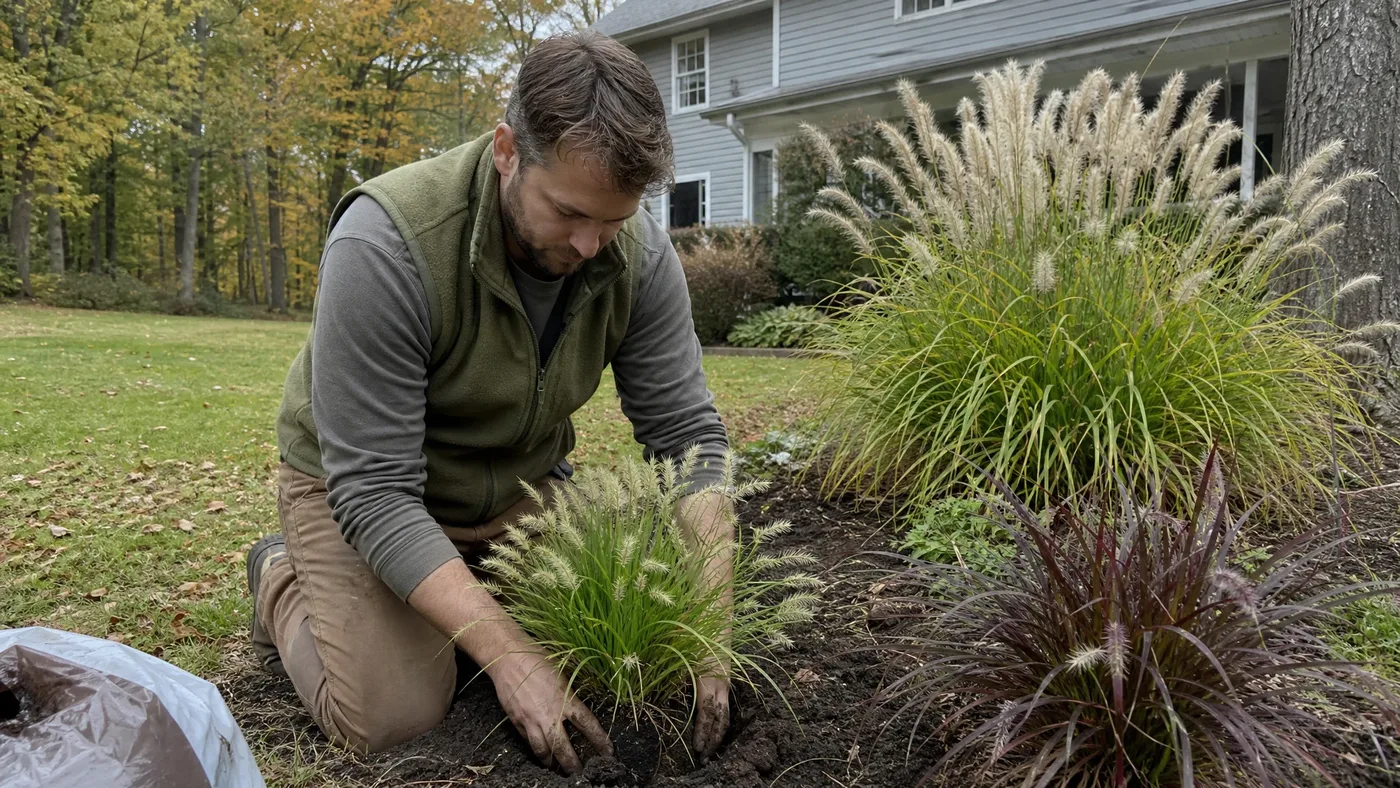
Dwarf Fountain Grass vs Burgundy Bunny: Size and Color
"The tag says it stays tiny and turns burgundy. How much of that should I believe?" A customer asked us exactly that about Burgundy Bunny, and the fair answer is most of it, with two catches. It really is the smaller plant, and it really does go red. But it is not a Hameln, our standard Dwarf Fountain Grass, shrunk and dyed, and the two behave differently in a yard.
Pick wrong and a "small" grass swallows a narrow bed, or the plant you wanted for height vanishes behind the lavender. This guide covers everything you need to know about choosing between Dwarf Fountain Grass and Burgundy Bunny, from tight side beds and windy lots to hot deck pots, front borders and the color claim itself.
A Narrow Side Bed Beside the Driveway
Take a bed 18 inches wide between a driveway edge and a fence. It is a common setup, and it is where plant tags mislead people most. Hameln spreads 2 to 3 feet, so its arching leaves lean out over the concrete by midsummer and brush every car door that parks beside it. Burgundy Bunny matures at 12–18 inches tall and wide, which is the width of that bed.
Width Decides This Bed
Height is the number shoppers look at first, but in a tight strip width is the one that decides. A clump ends up at its mature width whatever size the pot was at purchase. Hameln is a clump former and does not creep sideways, yet it keeps filling the same round footprint year after year. Cutting it back resets the height. It does not shrink the clump.
What we tell customers is to match the mature width to the bed, not to squeeze the bed around the plant. Both plants want full sun, and a driveway strip usually delivers it, plus reflected heat off the pavement, which neither plant minds.
Setting the Tape Measure to Work
Here is the arithmetic that settles most of these beds. A round clump should sit with its center at least half its mature width from any edge you do not want it touching. For Hameln at 2 to 3 feet, that is 12 to 18 inches from the concrete. For Burgundy Bunny at 12–18 inches, it is 6 to 9 inches.
Run those numbers before you shop. If the first one leaves you with a plant hanging over the pavement, the tag has already told you the answer, and no amount of trimming fixes it for long.
When Hameln Still Earns the Spot
If the strip is wider than Hameln's 2 to 3 feet of spread, or it runs along a wall where you want something to soften the lines, Hameln is the better plant. It works as a screen, border or specimen, and a row of Burgundy Bunny at 12–18 inches will never screen anything. Hameln also gives a narrow bed some height, which Bunny cannot do.
Our verdict is simple. If the bed is narrower than Hameln's mature spread, plant Burgundy Bunny and enjoy not having to trim it off the car. Wider than that, the decision is about height and color, not fit.
Dwarf Fountain Grass on a Windy Corner Lot
A corner lot gives the wind a clear run at everything in the front yard, and a grass that stands 2–3 feet with plumes on top can catch it like a sail. Hameln's arching leaves and heavy bloom do move in a gust. That sounds like a weakness, but K-State describes it as a very compact, heavy-blooming fountain grass, and the species it came from is larger, with clumps 2 to 4 feet tall and wide.
None of the sources we rely on rate wind tolerance, so what follows is our read, not a measured figure. In our rows, the plumes are what a gust grabs first, and the clump itself stays put.
Why We Pick Hameln for Exposed Lots
Open lots are usually full sun, which Hameln wants. NC State calls the species drought-tolerant once established, which helps where wind dries the soil, and slightly salt-tolerant, which may matter if your corner gets road spray. Treat that as a hint about the species, not a promise for a plant beside a salted street.
From the street, a 2–3 foot clump also reads as a plant, not a speck. Its foliage turns bronze in fall and stays fairly intact over winter, so the corner keeps some structure when everything else is cut down. Plant it in a drift, not a lone clump, so the group holds its shape in the wind.
Where Burgundy Bunny Fits Instead
At 12–18 inches Burgundy Bunny gives the wind very little to grab, so it is fine at the front edge of an exposed bed. The problem is scale. On a big open lot, a 15-inch plant seen from the curb is a smudge of red. Use it near the door or walk, where people see it up close.
Exposure also means colder winters. UF/IFAS lists Hameln for zones 5 through 8, while one source lists Burgundy Bunny for zones 4 to 9. We would not bet a zone 4 winter on a single listing, so check with your local extension service. Our hardiness zones guide covers how Hameln handles the cold.
The Hot Deck Pot and Dwarf Fountain Grass
A south-facing deck in July is about as hard on a container as it gets: hot boards, reflected heat and a pot that is dry by late afternoon. Burgundy Bunny is the plant most people reach for here, and the Conservation Garden Park listing says it works well in containers as well as borders and mass plantings. That claim holds up, with one adjustment to how you read the size.
The 12–18 inches is the plant's mature size. The pot adds to it. A 15-inch grass in a pot a foot tall stands well over 2 feet from deck to plume, and that is the height you will actually see. Plan the view, not just the plant.
Hameln in a Pot
Hameln will grow in a container, but 2–3 feet of plant on top of a pot is top-heavy in a breeze, and it needs a large, heavy pot to stay upright. It also needs more water. The drought tolerance NC State describes applies to established plants in the ground. In a pot the roots cannot go deeper, so watering is on you all summer.
Our container growing guide covers pot sizes and watering in detail. Whichever plant you choose, a pot needs drainage holes, because the grass prefers dry to moist, well-drained soil and a waterlogged pot is the opposite.
Sun and Bloom on the Deck
Hot decks are bright, and that suits both plants, since the species wants 6 or more hours of direct sun a day. The cultivar flowers in summer and fall, so a deck pot gives you plumes right where you sit in the evening. Burgundy Bunny carries white plumes over its red streaks, and Hameln carries purple-tinged ones.
Winter on the Deck
Roots in a pot sit in the open air, so they get colder than roots in the ground. Treat your climate as harsher than the zone number suggests and ask your local extension service how much protection a potted grass needs where you live.
Our verdict is Burgundy Bunny for nearly every hot deck. Choose Hameln only if you want a single large statement pot and will keep it watered. We grow both, and we would rather you buy for the mature size than for the cute pot you see at purchase.
Burgundy Bunny Beside Dwarf Fountain Grass Up Front
Plant them side by side along a front walk and the difference is plain from the street. Hameln stands about twice as tall, with green foliage and purple-tinged plumes in late summer. Burgundy Bunny sits low, streaked with red and topped with white plumes. The table lays out what the sources say about each plant.
| Trait | Hameln | Burgundy Bunny |
|---|---|---|
| Mature height and width | 2 to 3 feet | 12–18 inches |
| Summer look | Green foliage, purple-tinged plumes | Deep red streaks, white plumes |
| Fall color | Bronze to golden russet | Entirely red |
| Hardiness zones listed | 5 through 8 | 4 to 9 (one source) |
Layering the Two
The natural layout puts Burgundy Bunny in front and Hameln behind, so the red sits at eye level and the taller plumes backlight it. The height gap works in your favor here. Hameln at 24 to 36 inches and Bunny at 12 to 18 gives you two clear tiers, with no plant hiding the other.
Spacing follows each plant's own mature width, not a shared number, and our spacing guide shows how to set it out.
Why We Keep the Rows Separate
One of the most common questions we get is whether to mix them in a single row. We say no. A gap of about 12 to 18 inches in height makes a ragged line, and the small plant looks like a mistake. Tiered rows look planned.
Keep each tier to one plant, repeated in a drift. Three or four Burgundy Bunnies in a group read as a red band, where a single one reads as a stray. UF/IFAS also notes that, unlike the species, this cultivar does not re-seed itself, so the back row stays where you put it.
A Third Option
If neither size fits, there is a third small cultivar to consider. Our Little Bunny comparison covers where it sits against Hameln, and the same rule applies: look at mature size before you look at the photo.
Does Burgundy Bunny Really Stay Burgundy All Season?
Customers who buy it in May sometimes write to us in July asking why it is not burgundy. The honest answer is in the plant's own description. The Conservation Garden Park says deep red streaks highlight the grass through the summer, followed by white plumes, and that it turns entirely red in fall. Streaked is not solid, and the full red arrives late.
So the tag claim is half true. Burgundy Bunny carries red from midsummer on, but it is a streaked plant for months before it becomes a red one. The sources do not describe spring color, so we will not promise one.
What Hameln Does by Comparison
Hameln stays green through the summer, then changes. K-State notes that it turns bronze in fall and remains fairly intact through the winter, and the fall color runs to golden russet. Warm tones, not red. Our fall color guide explains why.
Judging the Claim
If you want red from June, no plant in this comparison delivers it. If you want a small grass that reads red by fall, Burgundy Bunny does. Pair it with something that carries the summer, and let the grass be the autumn payoff.
The better test of a color claim is the wording. "Burgundy" on a tag photo is a snapshot of one week. "Streaked in summer, red in fall" is a season-long description, and that is the one we trust.
Planning Around the Color
Fall is when the two plants sit best together. Red in front and bronze or russet behind is a warm, layered finish that needs no extra planting. Both bloom into fall, so the plumes are still up while the foliage shifts. Skip the idea of a summer-long red hedge from this plant, and plan the bed for the months when the color actually shows.
Which Yard Gets Which Dwarf Fountain Grass
Burgundy Bunny goes in the narrow side bed, in the pot on the hot deck, and at the front of a border where people see it up close. Hameln goes on the windy corner, behind the Bunny in a tiered border, and anywhere you need 2–3 feet of height. Both ask for full sun. Neither asks for much else.
Dwarf Fountain Grass
Nursery-grown Dwarf Fountain Grass in sizes from Quart Plant, shipped to your door.
From $49.49
Shop Now →Our Dwarf Fountain Grass grows on our own farms in bright sun and soil that drains quickly, so each clump is sized true to the mature height and spread you are comparing. We raise every plant we sell there, and we offer only top-quality grasses. Whether you favor Burgundy Bunny or Hameln, browse what is in stock now.